Why Teenagers Are More Vulnerable to Social Media Than Adults: A Psychologist on Dopamine, Identity, and How Parents Can Help

Updated: Oct 15
BBC NEWS ARABIC — NUQTAT HEWAR · December 3, 2021
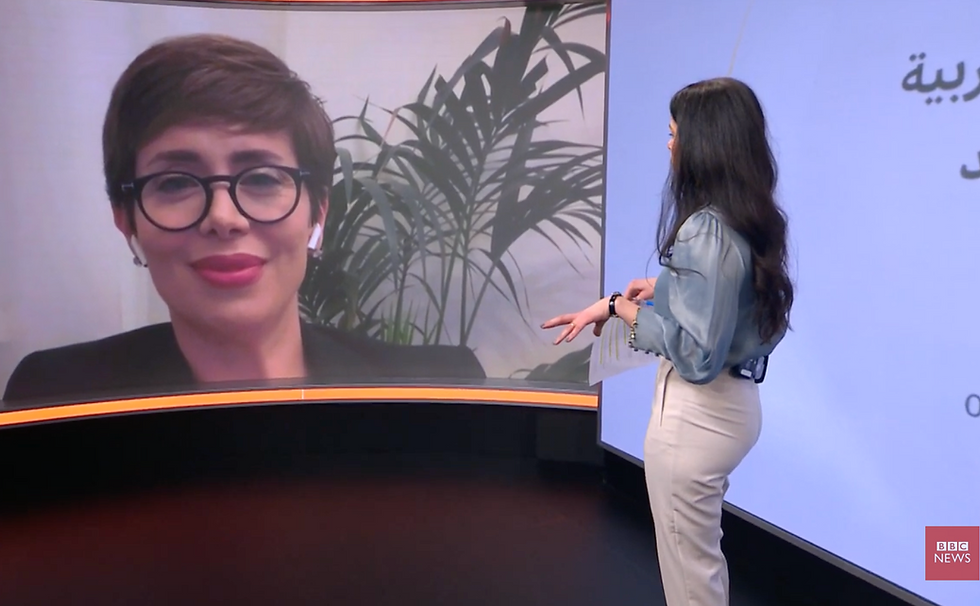
Sarah El Nabulsi, M.Sc., M.A., M.A., DHA Licensed Clinical Psychologist, joined host Yasmine Abu Khadra on BBC News Arabic's Nuqtat Hewar for a panel on protecting teenagers through the psychological crises of adolescence — including a question that shapes how an entire generation is growing up: why does social media affect a teenager so much more powerfully than it affects an adult, and how can parents intervene without pushing their kids further away?
The Teenage Brain Isn't a Smaller Version of the Adult Brain
The host opened with something many parents have heard but perhaps not fully understood: that likes, comments, and social validation trigger dopamine in social media users, and that the absence of that interaction can trigger something closer to a low, even depressive, state. She asked me to explain it — and, critically, how parents can intervene without alienating their teenagers in the process.
The starting point I always come back to is this: the teenage brain is genuinely more vulnerable to the effects of social media than the adult brain, and that vulnerability is developmental, not a matter of character or discipline. The prefrontal cortex — the part of the brain responsible for modulating addictive behaviour, regulating negative emotion, weighing the consequences of our actions, and building self-awareness — does not fully mature until somewhere between the ages of 21 and 25. Research on adolescent brain maturation confirms this timeline closely: this region continues an extended process of pruning and specialisation well into the mid-twenties, which is precisely why teenagers, as a matter of neurodevelopment, struggle more than adults to self-regulate.
This matters directly for social media, because platforms are engineered around exactly the reward system a developing brain hasn't yet learned to modulate. Every like, comment, or notification activates the brain's reward circuitry — the nucleus accumbens — the same pathway implicated in other addictive behaviours, and adolescents are neurologically primed to be more sensitive to this social feedback than adults are. Without a fully developed prefrontal cortex to provide the self-referral and self-awareness needed to regulate that pull, a teenager is far more exposed to whatever they encounter online — and it can affect them intensely. This is a significant part of why we see such high rates of eating disorders and negative self-image among teenagers correlating with social media use; this link has been formally recognised at the public health level, including in the U.S. Surgeon General's 2023 advisory on social media and youth mental health, which specifically flagged body image disturbance and disordered eating as documented risks of heavy adolescent social media use.
When Parents Mean Well but Get the Approach Wrong
I also wanted to address something I see constantly in my practice: parents who genuinely want to help their teenager reduce their social media use, but who go about it in a way that backfires.
Often, well-meaning parents become harsh — resorting to name-calling or blanket criticism of "always being on your phone" rather than addressing specific behaviours. This approach adds more stress onto a teenager who is already struggling to self-regulate, and it does nothing to help them moderate their own relationship with social media. If anything, it can push them further into the very behaviour the parent is trying to reduce, because teenagers at this developmental stage are, by definition, more vulnerable to developing addictive patterns — criticism alone doesn't address the underlying regulatory gap.
Why Today's Teenagers Face a Different Kind of Exposure
The host raised something I think about often: our generation grew up with a far narrower set of role models and influences than teenagers do today. She asked how being exposed to so many personalities from across the globe changes things for this generation.
Part of what makes adolescence what it is, developmentally, is that teenagers are still building and trying on different identities before settling into a more stable sense of self as they get older — that experimentation is normal. What's changed is the raw material they're experimenting with. Today's teenagers are exposed, constantly, to online personalities who are often dysfunctional or even pathological, with very few genuine morals — and who are nonetheless perceived to have achieved the things our culture associates with success: wealth, beauty, power, influence. A teenager at this stage is highly susceptible to internalising those perceptions, even when the underlying values are materialistic and fundamentally out of step with our own cultural values.
My advice to parents is to fight this proactively — not by restricting from a distance, but by staying genuinely close to what their teenager is engaging with, befriending them while never abandoning their role as the parent and authority figure in the relationship. I see this mistake often in families today: they struggle to find the balance between authoritarian and authoritative parenting. The research on this is well established — Diana Baumrind's foundational work on parenting styles, and the body of research that has followed it, consistently shows that authoritarian parenting (high control, low warmth) is associated with higher anxiety and lower self-esteem in children, while authoritative parenting — warmth and closeness paired with clear, consistent boundaries — produces the most well-adjusted outcomes. When a teenager feels both close to their parents and secure in their parents' authority and leadership, that combination creates the sense of stability and containment at home that is, developmentally, close to the ideal environment for preventing anxiety disorders from taking hold in the first place.
About Sarah El Nabulsi
Sarah El Nabulsi, M.Sc., M.A., M.A. is a DHA Licensed Clinical Psychologist (License No. DHA-75083705) based in Dubai, and UAE Director of the Transcendental Meditation Organization. She has been featured on MBC, MBC1, Sky News Arabia, Dubai TV, and BBC Arabic, and is the founder of the online courses Anxiety 101 (Level 1) and Master Yourself (Level 2).

Comments